Multi-cloud storage gateway for integration, control, and portability
Connect multiple cloud tenants and storage providers through one routing and policy layer, reduce fragmentation, and save engineering time.
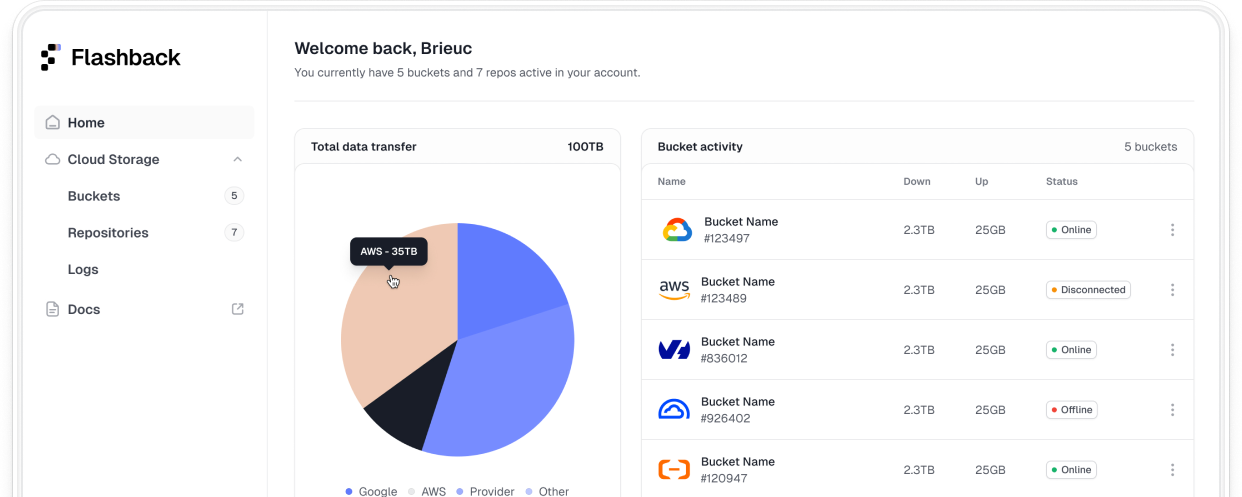

One control plane for storage across cloud and decentralized providers
Flashback orchestrates storage routing and policy enforcement across traditional and decentralized systems. Diversify storage across providers like AWS, Google Cloud, Walrus, and Filecoin—balancing affordability, performance, and privacy based on your strategy.
Unified integration
Connect providers and environments once. Standardize access patterns and reduce platform fragmentation.

Control without vendor lock-in
Define routing and residency rules and run gateways in your environment—while preserving provider choice.
Save engineering months
Use a single integration layer to reduce repeated work across providers, regions, and tenants.
Built to improve how modern teams store and move data
Flashback helps data-intensive applications focus on product delivery instead of storage complexity.

Made for AI workflows
Control where AI-generated data lands and build resilient storage pipelines for training, retrieval, and audit needs.

Built for Gaming
Support global streaming and content pipelines with low-latency access and policy-driven routing.

Designed for Finance
Enable analytics pipelines and archival strategies with stronger control over residency and cost.

Imagined for Modern Software
Improve performance for browser-first apps and real-time collaboration with flexible storage backends.
Frequently Asked Questions
Everything you need to know about the Cloud Storage Gateway.
A routing and policy layer for storage. It helps connect multiple storage backends and manage how data is stored and moved across them from one place.
No. Flashback is a gateway/orchestration layer. Your data remains in the storage systems you connect.
Flashback works with major object storage providers and compatible endpoints. If a provider exposes an S3-compatible API (or a supported integration), it can typically be connected.
Often minimal. Flashback can present a familiar S3-style interface and routing behavior; exact changes depend on your current SDK and auth setup.
Yes. Define routing rules so different data (or tenants) can land on different backends—supporting multi-cloud strategy and cost control.
You control where data is stored by selecting underlying locations and enforcing routing/residency policies.
Encryption is handled by your providers and your key strategy (provider-managed or customer-managed). Flashback is designed to work with standard encryption approaches.
Flashback is designed to orchestrate data movement across providers, including migration and replication workflows based on your policies.
Get centralized visibility into operational signals like request volume, error rates, and usage trends to support reliability and cost management.
Yes. Flashback supports deployment inside your environment to keep networking controls and security boundaries consistent.
Trusted by teams that need control over their storage